
Hanzade Acar, Forbes Türkiye
September 7, 2026
There are certain words in business that we use so often that, after a while, we stop questioning what they actually mean. Collaboration is one of them.
Nearly every company values collaboration. It appears among corporate values, is listed among the competencies expected of leaders, is measured in employee surveys, and is something we are constantly told we need more of in meetings. What is more, we have a fairly clear picture in our minds of what collaboration looks like: people who listen to one another, support one another, work in harmony, and are able to make decisions together.
But when you look at collaboration a little more closely, that picture begins to blur.
Because there are teams in which people treat one another with exceptional courtesy yet cannot work well together. There are leadership teams that never argue but cannot put their decisions into action. There are organizations where departments achieve every one of their own targets while damaging the company’s collective outcome. And there are companies where people remain silent throughout a meeting, only to have plenty to say the moment they walk out the door.
Perhaps we are looking for collaboration in the wrong place.
The issue is not how well people get along; it is what they do when they disagree.
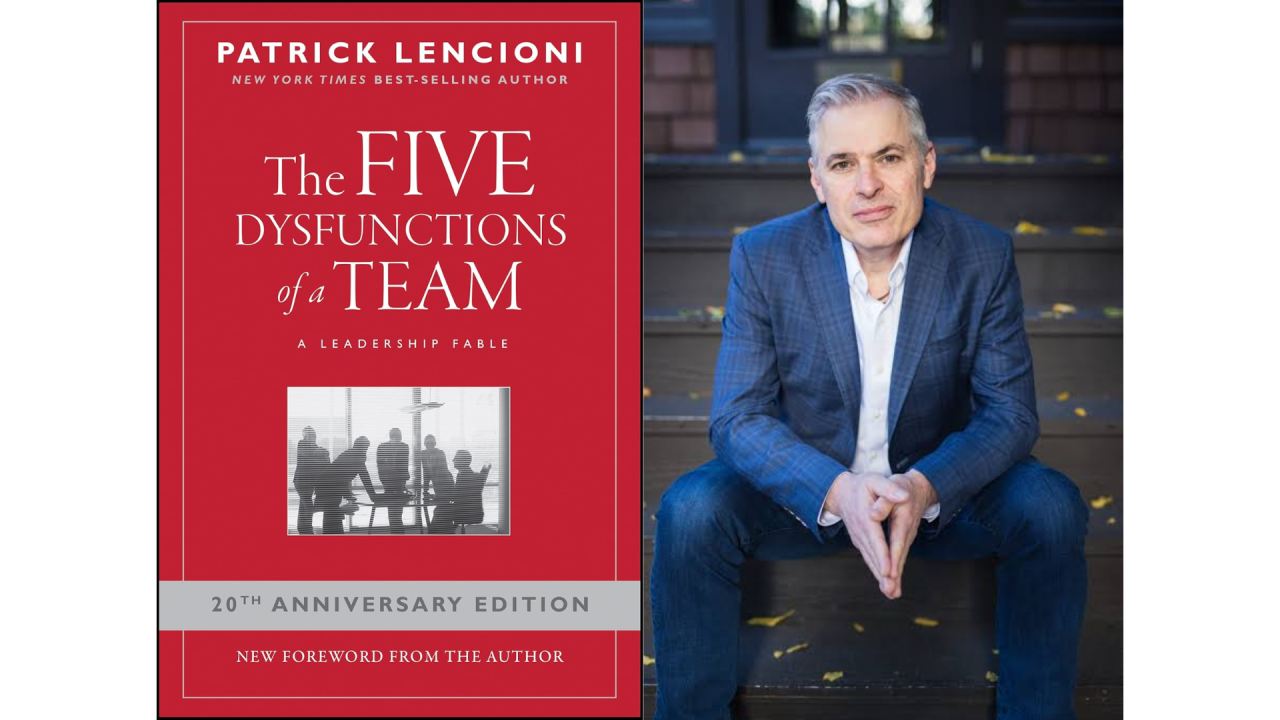
That is also what makes Patrick Lencioni’s The Five Dysfunctions of a Team (Ekiplerin Beş Temel Aksaklığı) still so interesting today.
The book was published in 2002 by Jossey-Bass, under the Wiley umbrella. Yet it did not create a huge sensation when it first appeared. Its own story unfolded much like the idea it describes: it passed from one executive to another, from one team to the next. Over time, it entered The New York Times bestseller list and remained on The Wall Street Journal business books bestseller list for more than 20 years. Today, it has been translated into more than 30 languages and has sold over 5 million copies.
It is rare for a management book written more than two decades ago to still be sitting on companies’ desks.
Perhaps one reason is that Lencioni did not actually write a management book in the conventional sense.
More a Story Than a Management Book
As its subtitle suggests, The Five Dysfunctions of a Team is a “leadership fable” a fictional business story about leadership.
At the center of the book is a fictional technology company called DecisionTech and its new CEO, Kathryn Petersen. When Petersen takes over, she encounters a leadership team that, at first glance, appears remarkably strong. Its members are experienced, intelligent, and successful in their respective fields. The company’s resources are no less impressive than those of its competitors.
But the team does not work.
The problem is not a lack of talent.
As the story unfolds, Lencioni reveals five invisible fractures within the team: absence of trust, fear of conflict, lack of commitment, avoidance of accountability, and inattention to collective results.
What matters most, however, is not simply the existence of these five behaviors, but the relationship between them. They are not five separate problems sitting side by side. Each one feeds the next.
When there is no trust, people do not reveal what they truly think. When genuine thoughts are not voiced, healthy conflict does not occur. Decisions that have not been debated are not fully embraced. When decisions are not owned, no one holds anyone else accountable for them. Eventually, everyone retreats into their own area, their own target, their own success.
What Lencioni means by “trust” is particularly important.
He is not talking about believing that a colleague will complete their work on time. He is talking about a person being able to say, in front of others, “I don’t know,” “I made a mistake,” “I need help,” or “You are better at this than I am.”
These are not easy sentences to say in business. Because for years, we have been taught that leadership is about knowing, competence is about being able to solve problems, and success is about standing on your own two feet.
Yet sometimes the sentence that changes the fate of a team is not “I’ll handle it,” but “I can’t handle this on my own.”
To see how this works, we need only look at something that appears quite ordinary in the Netherlands: home healthcare.
Teams Without Managers
In 2006, Dutch nurse Jos de Blok looked at the healthcare system he had worked in for years and began pursuing a simple question: Why had the care a patient received at home become so complicated?
In the name of greater efficiency, the system had divided the work into pieces. There were managers, planners, coordinators, and employees carrying out different tasks. Who would do which job and how long it should take was calculated, and scheduling was handled centrally. Yet amid all this organization, something strange had happened: the nurse who should have known the patient best had gradually lost authority over their own work.
De Blok founded Buurtzorg instead.
Meaning “neighborhood care” in Dutch, Buurtzorg had a surprisingly simple way of working. Small teams of no more than 12 nurses would take responsibility for patients in a particular area and manage themselves.
There would be no team managers in the conventional sense.
Who would care for which patient? How would the work schedule be organized? How would responsibilities be shared? Was a new colleague needed? What should change when things were not going well?
The team would decide.
Within its first 10 years, the model grew to more than 10,000 nurses and 850 teams. Moreover, as Buurtzorg expanded, rather than adding new layers of management to the middle of the organization, it preserved its structure of small, self-managing teams.
But the most interesting aspect of the Buurtzorg example is not the absence of managers.
It is that the work managers normally do still gets done.
Someone still has to create the schedule. Someone has to raise problems, follow up on decisions, select new people, and discuss performance.
There is simply no longer one person doing all of it.
The team does it.
So removing the manager does not eliminate conflict. On the contrary, it moves the responsibility for dealing with different views, making decisions, and taking responsibility for those decisions into the team itself.
Trusting a team does not mean saying, “Do whatever you want.”
It means believing that people can be responsible not only for their own work, but also for the way they work together.
Management did not disappear at Buurtzorg.
Managing simply stopped being one person’s job.
This is one of the more advanced forms of collaboration: not only being able to work together, but being able to take responsibility together.
Where There Is No Conflict, There May Be No Harmony
The second level of Lencioni’s model is even more uncomfortable: fear of conflict.
Because in companies, we tend to treat conflict as something inherently negative. Statements such as “We are a very harmonious team,” “We never have conflict,” and “Our meetings are always very positive” are offered as compliments in many organizations.
But is that really a good thing?
According to Lencioni, teams without trust cannot engage in genuine conflict of ideas. Instead, what emerges are carefully controlled comments, half-hearted objections, and artificial harmony. The real conversations often take place after the meeting.
The opposite of collaboration is not always conflict.
Sometimes it is silence.
If everyone on a team thinks the same way, perhaps they have achieved extraordinary harmony. But there is another possibility: people may not believe it is safe to say that they think differently.
That is why the measure of a good meeting should not simply be how well people listen to one another or how quickly they find common ground; it should also include how comfortably they can challenge one another.
The distinction here is important. The conflict Lencioni advocates is not personal conflict, but conflict between ideas. It is the ability to put thoughts, rather than people, on the table.
Because it is difficult to test the resilience of decisions without allowing ideas to collide.
And this brings us to another misconception about collaboration.
Not everyone has to agree.
Commitment, the third level of Lencioni’s model, does not mean consensus. When people know that their views have genuinely been heard, they can stand behind a decision even if their own preference is ultimately not chosen.
True collaboration is not found in the sentence, “We all think the same way.”
It is found in the sentence, “We thought differently, we talked, we made a decision; now we move forward together.”
How Many Different Minds Does It Take to Design a Shopping Cart?
In 1999, the American television program Nightline approached the design company IDEO with an unusual challenge: redesign an ordinary shopping cart and show the entire process on camera.
They had five days.
At first glance, the subject might not seem particularly important. After all, we are talking about a shopping cart.
But the first thing IDEO did was not to gather only people who designed shopping carts around the table.
People from different backgrounds and areas of expertise began looking at the problem from different angles. The team went to supermarkets, observed customers and employees, and studied how existing carts were being used.
They explored different problems associated with the same object, including safety, children, shopping behavior, product separation, and the checkout process.
Then, instead of choosing a single “best idea,” the teams developed different solutions.
Some focused on safety. Some on the shopping experience. Some on the time spent at checkout. Some on how children were transported in the cart.
In the final stage, the strongest elements of these ideas were combined into a single prototype.
The resulting shopping cart did not become the new standard used in supermarkets around the world today. But that is not the important part of the story anyway.
What matters is that IDEO did not ask different people to look at the same problem in the same way.
It did the exact opposite.
It asked them to look differently.
Because the value of interdisciplinary work lies not only in everyone bringing a different area of expertise to the table. It lies in those areas of expertise being able to change one another’s thinking.
When one person’s idea stops being an alternative to someone else’s and becomes raw material for it, collaboration moves to another level.
That is why the result of good collaboration is not always “My idea won” or “Your idea won.” What ultimately emerges is a third idea that no one at the table had conceived alone at the beginning.
How Many People Can Fit on a Stage?
When Bad Bunny took the stage during the Super Bowl LX halftime show in February 2026, millions of people naturally looked at him.
But what made the performance interesting from the perspective of collaboration emerged when we took our eyes off Bad Bunny for a few minutes.
Because there was not just one artist on that stage.
There was a sugarcane field, a casita evoking Puerto Rican homes, people playing dominoes, street vendors, musicians, dancers, and people from different generations. With guests including Lady Gaga and Ricky Martin, a small Puerto Rican world had effectively been created in the middle of a massive sporting event.
Behind all of this was an even larger team, ranging from creative directors to choreographers, musicians to designers, production crews to performance artists from different backgrounds.
What was interesting was that not everyone on stage came from the same cultural background.
Some of the dancers who shared their experiences after the performance were not Puerto Rican. They came from different backgrounds, yet they had become part of a shared story larger than themselves.
This is where culture and collaboration intersect.
Because a strong culture does not have to make everyone the same.
On the contrary, it grows stronger when people can find a place for themselves within a shared story without losing their differences.
Bad Bunny was at the center of the stage that night.
But the story being told was not his alone.
And that creates an unexpected similarity between leadership and art: being at the center and making everything about yourself are not the same thing.
In an orchestra, the violin does not need to sound like the cello. The trumpet does not need to resemble the piano. In fact, if they all played the same note, they would not create music.
What creates the music is the ability of different voices to make room for one another within the same composition.
Perhaps in companies, we define collaboration a little too much through the idea of “harmony.”
Yet the point is not for everyone to produce the same sound.
It is for different voices to be heard within the same piece.
The Order the Captain Never Gave
A similar transformation took place in another closed system, this time aboard the U.S. Navy nuclear submarine USS Santa Fe.
When David Marquet took command of the submarine, he found himself confronting a problem that ran directly counter to the traditional military order.
The conventional model aboard submarines was clear: the superior knows, the subordinate executes.
Marquet began to change this.
Instead of having people say, “I request permission,” he asked them to state what they intended to do. He pushed decision-making authority down toward the level where the information relevant to that decision actually existed.
Beneath what seemed like a tiny change in language was a much bigger idea.
A person who says, “I request permission” still sees the ownership of the decision as belonging to someone else.
A person who says, “I intend to do this,” however, must think, evaluate, and take responsibility for the decision.
When responsibility exists only at the top, those below simply carry out tasks.
When responsibility is distributed, people begin to take ownership.
This is where the fourth level of Lencioni’s model comes into play: accountability.
In companies, most people avoid telling a colleague, “You didn’t do this,” “This behavior is affecting the team,” or “You fell short of the commitment we made here.”
Because we do not want to damage the relationship.
Yet here is the paradox: avoiding accountability does not protect the relationship.
It allows standards to quietly decline and resentment to grow. Eventually, team members stop holding one another accountable and begin waiting only for the manager to do it.
Remaining silent about a colleague’s performance is not always an act of kindness.
Sometimes it is giving up on being a teammate.
I Won, We Lost
At the very top of Lencioni’s pyramid are results.
And this is where another very familiar trap of corporate life begins.
The sales team hits its target. Operations meets its cost target. Marketing launches its campaign on time. Finance protects the budget.
Everyone is successful within their own box.
But the company loses.
This is where what Lencioni calls “inattention to results” emerges: when individual status, personal targets, or departmental success take precedence over the collective outcome, a team loses what makes it a team.
One of the hardest questions we need to ask in companies is this:
Does my success become our success?
Because the most beautiful violin solo in an orchestra can ruin the piece. A football player’s statistics can improve while the team is relegated from the league. A department can protect its budget while the company loses its customer.
Collaboration is not people working side by side.
Nor is it attending the same meeting.
Even helping one another, on its own, is not enough.
The real test of collaboration is whether one person’s success makes another person’s success possible.
So, When Does the Real Meeting Begin?
Companies do not need major culture surveys to understand whether collaboration truly exists.
The five minutes after a meeting are enough to measure it.
Do people say the same things outside the room that they said inside it?
Or do their ideas find courage only after the door has closed?
Can someone say “I don’t know” in the meeting? Can the most junior person challenge the opinion of the most senior? Can one colleague remind another of a commitment they made? Can a department give up one of its own targets to make room for another department in pursuit of the company’s collective outcome?
Most importantly: When an idea comes to the table, are people concerned with who said it, or with what they can turn it into together?
At Buurtzorg, management did not disappear; it was distributed throughout the team.
At IDEO, different areas of expertise did not compete for superiority; they changed one another.
On the Super Bowl stage, different voices and identities did not disappear; they became parts of a shared story.
Aboard USS Santa Fe, the captain did not empower people by making more decisions; he shared with them the responsibility of being able to make decisions.
In none of these examples were people the same. They did not know the same things. They did not do the same work. Nor did they agree on everything.
But at some point, the line between “my work” and “your work” was replaced by “our outcome.”
That is where real collaboration began.
Not where everyone agreed with one another.
But where everyone acknowledged that they needed one another.
The strength of an orchestra does not come from all its instruments producing the same sound. It comes from each one carrying a sound that the others do not.
The same is true of teams.
A strong team is not a group of people in which everyone does their own job flawlessly. It is made up of people who make it possible for one another to do good work.
Link : https://www.forbes.com.tr/icerik-ureticileri/asil-toplanti-ne-zaman-basliyor
