
Mehmet Acar, Forbes Türkiye
September 14, 2026
The words we use to define people, products, and companies help us understand them. But could those same words also be hiding possibilities we have not yet seen?
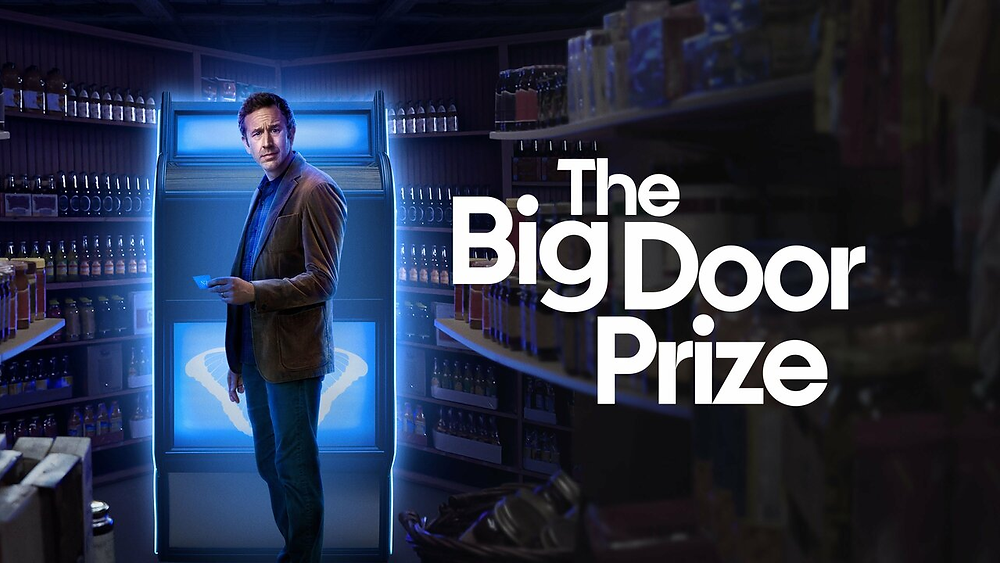
Suddenly, a blue machine appears right in the middle of the grocery store.
There is a picture of a butterfly on it. Its name is Morpho. In exchange for a few pieces of information, a fingerprint, and two dollars, it gives you a small card.
The card does not tell you your future.
Nor does it tell you how successful you will be.
There are only two words:
Life Potential in other words, your potential in life, the things you may be able to achieve.
The Big Door Prize, which premiered on Apple TV on March 29, 2023, begins with this intriguing idea. Adapted from M.O. Walsh’s novel of the same name, the series was created by David West Read, an Emmy winner for Schitt’s Creek. Chris O’Dowd stars in the leading role. Produced by Skydance Television, the series had its world premiere at SXSW. It was renewed for a second season immediately after its first and was rated “Certified Fresh” by the film review platform Rotten Tomatoes.
The town of Deerfield, where the story takes place, is initially an entirely ordinary American town.
Until Morpho arrives.
One by one, the townspeople step up to the machine. But when Morpho begins telling them what they could become, what they have been until that moment suddenly begins to seem less sufficient. Dusty Hubbard is one of them. He is a high school teacher. Married. He has a child. He does not appear particularly unhappy with his life. But when everyone around him begins reevaluating their lives, relationships, and choices by looking at the cards Morpho has given them, Dusty is confronted with an unsettling question:
What if another life is possible for me too?
As I watched The Big Door Prize, after a while, a different question began to interest me more than whether Morpho actually knew people’s potential accurately.
What happens the moment we tell someone what their potential is?
Because companies do not have Morpho machines, but they do have cards: High Potential, Future Leader, Technical Expert, High Performer, Creative, Analytical, Not Ready Yet, Not Suited for Leadership…
Each of these may sometimes be the result of an assessment center, sometimes the output of a talent program, sometimes our position on a nine-box matrix, and sometimes simply a single sentence a manager has formed about an employee.
In my experience, the question we really need to ask is not how accurately these cards define people. It is how many different possibilities we can no longer see once a card has defined someone.
Potential Lock: Could We Actually Be Blocking Potential While Trying to Find It?
When you look at the origins of the word “potential,” you encounter an interesting contradiction.
The Latin potentia means power, capacity, the ability to do something. Potentialis, derived from the same root, describes something that has not yet been realized but has the capacity to be realized.
So, at the root of the word, potential is not an outcome.
It is a possibility.
There is a similar idea in Aristotle’s distinction between potentiality and actuality: the capacity of something to become something else is not the same as what it ultimately becomes. More than 2,000 years have passed since then. Today, in organizations, we try to measure, classify, and name potential. There is nothing wrong with that. Of course, we need assessments in order to develop people, give them the right responsibilities, and prepare future leaders. But there may be a paradox here. Because the moment we give a possibility a name, we make it more visible. At the same time, we may be making other possibilities less visible.
I call this Potential Lock.
If we define a person, a product, or a company too early based on the information we have today, over time that definition stops being an observation and becomes a boundary.
To see how this happens, let us leave Deerfield and move to a chessboard. In a series of experiments conducted by Merim Bilalić, Peter McLeod, and Fernand Gobet with chess masters, players were shown problems that had a familiar solution alongside a better but less familiar one. The result revealed an unsettling truth about expertise.
When expert players saw the good and familiar solution, they could struggle to find the better one. This phenomenon, known in psychology as the Einstellung Effect, shows that when a solution we already know has worked before becomes dominant in our minds, it can prevent us from seeing a better solution.
The most interesting point here is not that people fail to find a solution. Quite the opposite.
The problem is that they find a good solution too early.
This distinction explains, for me, an important part of the discussion around potential in organizations. Sometimes the problem with people may not be that we do not know them well enough. It may be that we are too certain that we know them.
This made me think of some of the talent meetings I have attended over the years. In these meetings, there is always a name on the table, everyone takes turns giving their opinion, and after a while, several years of that person’s work begin to fit into a handful of adjectives: A very good expert, but not a leader. Reliable, but not strategic enough. Creative, but weak on the commercial side. And the people making these statements often genuinely know that person very well. This has always bothered me. It is relatively easy to notice a wrong judgment. But what about a judgment that appears to be right? How often do we go back and check whether a sentence that was genuinely true three years ago is still true today? More importantly, after forming that sentence, do we really give the person in front of us an opportunity to reveal another side of themselves? Sometimes I think that some of the doors in front of people may be closed not by bad managers, but by good managers who believe they know them extremely well. If you ask me what the solution is: Change the system and the culture that locks the doors of that system.
That is also the power and fascination of Morpho. The machine does not merely show you one possibility. Once you have seen that possibility, it also changes the window through which you look at the world.
Companies have their own Morpho cards too.
“We are an automobile company.”
“We serve premium customers.”
“We are B2B.”
“We are not a technology company.”
“We don’t do that.”
All of these statements may be true today. But being true does not make them safe for the future.
Sometimes the Future Is Not What We Sell
When William Wrigley Jr. arrived in Chicago in 1891, he had not come to build a chewing gum empire. He was selling soap. To increase sales, he began giving his customers baking powder as a promotional gift. After a while, something strange happened. People were more interested in the baking powder that came with the soap than in the soap itself.
Wrigley changed the product. He began selling baking powder. This time, he gave chewing gum as a promotion. The same thing happened again. People paid more attention to the gift than to the product.
Wrigley changed direction once more.
In 1893, Juicy Fruit and Wrigley’s Spearmint were launched.
Looking back today, it seems almost inevitable that Wrigley would become a chewing gum company.
It was not.
For a time, the company’s future was not in what it sold, but in what it gave away for free in order to sell.
Around the same period, another door-to-door salesman was receiving a similar signal from his customers.
David H. McConnell sold books. While making sales, he gave his customers small perfume samples as gifts. Then he noticed that customers were more interested in the free perfumes than in the books.
McConnell did not ignore this signal.
In 1886, he founded the California Perfume Company. Years later, the company would become known as Avon.
What interests me most about the stories of Wrigley and McConnell is not that they changed industries.
There is something else that is more interesting:
Their customers saw something in their companies that they themselves had not yet seen.
That is why I am not sure strategic foresight is always about predicting what might happen in the future. Sometimes the signal of the future is already inside the present. The problem is that we have placed it in the wrong category.
But there are even more surprising examples.
In the early 1950s, Corning scientist S. Donald Stookey was working with glass in a laboratory furnace. The temperature in the furnace rose far above what had been planned. Stookey expected to find a mass of melted glass, but instead encountered an opaque, white, and surprisingly durable material. In fact, when he dropped the piece while removing it with tongs, he saw that it did not break.
This accident led to advances in the field of glass ceramics. The extraordinary heat resistance of the resulting Pyroceram family did not remain confined to the laboratory. The technology later formed the basis for the development of CorningWare. The durability of the same family of materials was also used in military applications for guided missile nose cones and later in space technologies.
On one side, missile technology.
On the other, a casserole dish going into an oven in the kitchen.
At first glance, two worlds that could hardly seem further apart.
But the question they share converges on the same material property:
Can it withstand extreme temperature changes?
This is the moment when innovation becomes most visible. The moment we stop asking which industry a technology belongs to and begin asking which problem it can solve.
Sometimes something may contain more than the name it has been given at that moment.
The Value of Misfit: Is It the Wrong Thing, or the Wrong Problem?
In 1957, two engineers in New Jersey, Alfred Fielding and Marc Chavannes, were trying to develop a new type of wall covering. They joined two sheets of plastic together in a way that trapped air bubbles between them.
The resulting product was quite unusual.
There was only one problem.
People did not want it on their walls.
If you look at it in terms of its intended purpose, the product was a failure.
Fielding and Chavannes, however, did not throw the material away. They searched for other uses.
A few years later, Sealed Air, the company they founded, saw the value of this material in solving an entirely different problem: protecting fragile products during transportation.
Bubble Wrap was born.
And protecting the new IBM 1401 computers during shipment became one of the material’s first major applications. A product that did not create enough value as wallpaper became a new category in the world of packaging.
I call this Misfit Value.
The fact that something does not fit the current problem does not mean it has no value.
Sometimes it simply means that its value is hidden in another problem.
This distinction may be just as important for people as it is for products.
When an employee fails to deliver the expected performance in a role, our first questions are generally about the person.
Are they good enough?
Do they have the competence?
Are they the right person?
Perhaps we should add another question:
Are they working on the right problem?
Because organizations, too, may have Bubble Wraps being evaluated as wallpaper.
The talent is there.
But the problem that would make its value visible is somewhere else.
The glass ceramic in Corning’s laboratory, Wrigley’s free chewing gum, and McConnell’s small perfume bottles all tell us the same thing in different ways.
Sometimes the most valuable part of the future is not at the center of the organization.
It is standing at the edge.
It is a promotion.
A by-product.
An accident.
An unexpected result.
Or a talent that has not yet encountered the right question.
Now let us return to The Big Door Prize.
Because what Morpho does is not this. In fact, it does the exact opposite.
It reduces uncertainty.
It gives you a card.
It gives something a name.
It makes one possibility visible.
And because the human mind does not particularly like uncertainty, that card can quickly turn into a comforting answer.
But answers may come at a cost.
Possibility Loss: How Do We Lose Something We Never Chose?
Companies are quite good at measuring losses.
A lost customer.
A lost employee.
A failed product.
A terminated project.
A missed sale.
A bad investment.
Most of these have a number attached to them.
But how do we measure the loss of a possibility that was never even considered?
The employee who was never given a leadership opportunity because a manager said, “They’ll never be a leader.”
The customer who was never tested because someone said, “We don’t enter that market.”
The use case that was never tried because someone said, “This product wasn’t made for that.”
The business that was never created because someone said, “That’s not what we do.”
But we cannot say that their economic value is zero either.
I call this Possibility Loss.
I am not talking about the cost of making the wrong choices.
I am talking about the cost of futures we can no longer even see as options.
The difference matters.
If Wrigley had continued to see chewing gum as a promotion, no one would have said, “They failed in the chewing gum business.”
Because the chewing gum business would never have begun.
If McConnell had seen his customers’ interest in perfume merely as a small detail that made sales conversations easier, there would have been no cosmetics company.
Because that company would never have been founded.
If the creators of Bubble Wrap had said, “The wall covering didn’t work,” and closed the project, today we would not look back and talk about a failed packaging innovation.
Because the packaging problem would never have been asked.
This is what makes Possibility Loss dangerous:
It leaves no trace.
It does not appear in the budget.
It does not show up on the dashboard.
It does not turn red in a management meeting because the organization does not even realize what it has lost.
That is why companies need to question from time to time not only the quality of the decisions they make, but also which options they no longer consider.
In a strategy meeting, there may be another question just as valuable as “What should we do?”
“What do we no longer even see as a possibility?”
The same question applies to people.
If we have defined an employee by the same competency for years, perhaps they really do have that competency.
But when did we stop exploring what else they could become?
An opinion we formed about a leader years ago may still be correct.
But when was the last time we tested it again?
A person’s past performance provides important data about what they may be able to do in the future.
But data and destiny are not the same thing.
This is where I bring my concept of Potential Lock back into the picture.
The more accurate a definition is, the easier it becomes to trust it.
The more we trust it, the less reason we have to search for alternatives.
The less we search for alternatives, the more accurate our definition begins to appear.
And eventually, something that began as an observation can become a system that produces its own evidence.
Like the first good move a chess master sees.
The problem is not that we found the wrong answer.
The problem is that we stopped looking for a better one.
What Does Your Morpho Card Say?
One of the smartest aspects of The Big Door Prize, in my view, is that after a while it pushes the question of whether Morpho is actually right into the background.
Because the moment people believe their cards, the accuracy of the machine is no longer the only issue.
The card changes behavior.
Behavior changes choices.
Choices change lives.
In organizations, the impact of the sentences we form about people can sometimes outlive the accuracy of those sentences.
“High Potential.”
“Operations person.”
“A very good expert.”
“Cannot think strategically.”
“Not good in front of customers.”
“Not ready for leadership.”
Perhaps some of these are extremely accurate at the moment they are said.
But The Big Door Prize makes me ask another question:
Does an accurate definition have an expiration date?
Because even in the origin of the word potential, there is no completed outcome.
There is power.
There is capacity.
There is the possibility of becoming.
There is a future that has not yet happened.
Of course, I am not arguing that companies should stop making assessments.
We have to assign people, allocate resources, make investments, say yes to some possibilities and no to others.
However, there is an important difference between a decision and an identity.
“I didn’t choose you for this right now” is one sentence.
“You are not suited for this” is another.
The first makes a decision about today.
The second can draw a boundary around tomorrow.
This is where the line that I have always argued leaders need to pay attention to begins.
Think of the residents of Deerfield standing in front of Morpho.
They pay two dollars.
The machine starts working.
The card comes out.
And people who, only a few seconds earlier, had countless possibilities in front of them are now looking at the few words in their hands.
There may be invisible Morpho machines inside our companies too.
In our performance systems.
In our talent meetings.
In our career paths.
In our organizational charts.
And sometimes in our own minds.
The task of organizations is not to hand out more accurate Morpho cards to people.
The real task is to remember that no card can write a person’s entire future.
Because the greatest obstacle in front of a person, a product, or a company is not that their potential goes unseen.
It is that their potential is defined too early.
Link: https://www.forbes.com.tr/icerik-ureticileri/ya-potansiyeliniz-size-soylenen-sey-degilse
