
Hanzade Acar, Forbes Türkiye
August 10, 2026
A New Measure: Joyspan
Humanity has long been in pursuit of a longer life. But never before have we turned that pursuit into such a systematic, measurable, and commercial endeavor as we have today. We no longer track only our weight, blood pressure, or how many steps we take each day. We measure our sleep stages, heart rate variability, blood sugar, stress, recovery capacity, and even our biological age. We try to sleep better, eat better, preserve our muscles, optimize our metabolism, and delay the effects of aging as much as possible. Longevity, once largely the domain of medicine, has now evolved into an entire lifestyle economy at the intersection of technology, hospitality, physical fitness, nutrition, and luxury consumption. In the city where I live, I see every day that the vast majority of people I encounter, from different professions, ethnic backgrounds, and age groups, use these tracking devices. In fact, a news story I came across just this morning was about a necklace that measures health metrics as a new wearable holistic health and wellness product.
In the midst of this transformation, a book published in August 2025 added a rather simple but unsettling question to the longevity conversation: We are going to live longer, but how much of that longer life will we actually spend enjoying being alive?
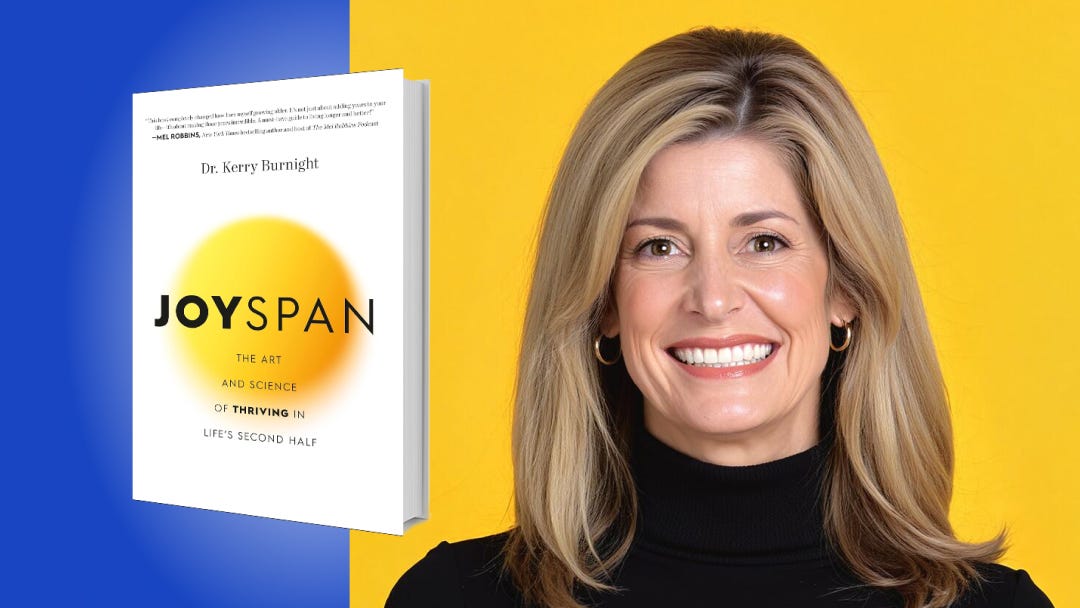
American gerontologist Dr. Kerry Burnight’s Joyspan: The Art and Science of Thriving in Life’s Second Half was published by Worthy Books, an imprint of Hachette Book Group, on August 5, 2025, and soon entered The New York Times bestseller list. Burnight holds a doctorate in gerontology and spent many years teaching geriatric medicine and the science of aging at the University of California, Irvine School of Medicine. For nearly thirty-five years, she has studied not only the physical dimensions of aging, but also its social and psychological dimensions. Joyspan is the culmination of all that experience, adding a third concept alongside two terms frequently used in the longevity world.
Lifespan describes how many years we live. Healthspan refers to how many of those years we are able to spend healthy and independent. Burnight’s concept of joyspan, however, asks how much of our lives we are able to preserve our curiosity, our relationships, our sense of meaning, and the pleasure we take in living.
In fact, the story of Burnight’s own mother explains very well why she felt the need for this concept. Her mother is 96 years old today. She has experienced heart failure, undergone knee surgery, lost her husband, and gone through a period of serious financial hardship. In other words, this is not the story of an extraordinarily fortunate person who has somehow been protected from illness, loss, or the difficulties of life. What caught Burnight’s attention was that, despite all of this, her mother’s world had not grown smaller. She still connects with people, maintains her sense of humor, remains curious, gets involved in other people’s lives, and continues to play an active role in her own. Burnight distills the difference she has observed over the years, both in her mother and in the people she has worked with, into four behaviors: grow, connect, adapt, and give.
At first glance, these have little to do with what comes to mind today when we talk about longevity. There are no supplements here, no cold plunges, no peptides, no biological age tests. Yet research suggests that these seemingly “more natural” dimensions identified by Burnight may be much more closely connected to our bodies than we think. In a large meta-analysis published in PLOS Medicine by Julianne Holt-Lunstad and colleagues, covering 308,849 participants across 148 studies, people with stronger social relationships were found to have an approximately 50 percent greater likelihood of survival during the study periods than those with weaker social relationships. The researchers considered the magnitude of this association significant enough to be comparable with many established health risk factors.
Another large study on optimism is similarly striking. Research published in the Proceedings of the National Academy of Sciences examined two large epidemiological cohorts and found that higher levels of optimism were associated with both longer life expectancy and a greater likelihood of living beyond the age of 85 in both women and men. Of course, these findings do not allow us to establish a simplistic cause-and-effect relationship such as “be optimistic and you will live longer.” Many variables are involved, from socioeconomic conditions to existing health status. But both studies reveal something important: Longevity does not happen only inside our bodies. It also happens within our relationships, our habits, our social environments, and the relationship we have with life itself. So, in a world where all these transformations are happening at extraordinary speed, instead of getting lost in them, we should choose to experience and learn without letting go of optimism.
These findings also remind me of the Netflix documentary Live to 100: Secrets of the Blue Zones, which I watched a few years ago and which has influenced the way I have thought about longevity ever since. Based on years of research by National Geographic explorer and author Dan Buettner, the documentary follows communities where people live extraordinarily long and healthy lives, from Okinawa to Sardinia, Ikaria to Costa Rica’s Nicoya Peninsula, and Loma Linda, California. As I watched, I noticed that many of the sophisticated methods we discuss today in the longevity world were absent from these people’s lives. Most do not know their biological age, do not measure their heart rate variability, do not go to the gym every day, and do not structure their lives around supplement regimens. Instead, they have movement naturally embedded into daily life, strong family and friendship bonds, communities to which they belong, a reason to get up in the morning, and small rituals that slow down the pace of life. After watching the documentary, I spent a long time thinking about these dynamics, conducting research, analyzing the longevity routines I apply in my own life, and evaluating their outcomes. We search for longevity by asking only what we need to add to our lives, while some of the world’s longest-living people show us that living well is often about how life itself is structured. With Joyspan, the questions the Blue Zones left with me resurfaced. Because there is a strong commonality between Burnight’s “grow, connect, adapt, give” and the ways of living Buettner observed in different corners of the world: People are not simply living longer; they are continuing to remain engaged in life.
To me, this is one of the most interesting paradoxes of our age. Never in human history have we known so much about ourselves. A ring can tell us how many hours we slept last night, how much of that was deep sleep, our heart rate variability, and how ready our bodies are for the day ahead. A sensor can show us how the food we eat changes our blood sugar. Laboratory tests can turn dozens of biomarkers into a report just a few pages long. Our lives have been measured. And let’s admit it: this technology also feels like an exciting adventure.
But can a device measure how much we laughed over dinner? Can it tell us how much we feel like ourselves when we are with a friend, whether we genuinely feel curious about the day ahead when we wake up in the morning, or whether the work we do holds a meaningful place in our lives? Of course it cannot. So, as we move forward with measurable data, are we actually missing our joyspan entirely? Yes.
One is the measured life; the other is the felt life.
This distance between the measured life and the felt life, I believe, will become one of the most interesting debates in the wellness industry in the years ahead. Because a human being is not merely a biological system to be optimized so that it functions better; a human being is a creature that feels the life it lives. Simply adding daily vitamins and protective products to the soil in which you grow your flower and watering it does not mean that flower will thrive. As long as you keep the curtains closed, your flower, unable to reach the sunlight, will eventually wither.
It is particularly interesting to observe this transformation in Los Angeles, where I live today.
A significant number of the new holistic health and wellness brands that have emerged in the city over the past few years no longer fit neatly into any traditional definition of a gym, health and wellness center, or clinic. Remedy Place in West Hollywood is one of the best examples. Describing itself as the world’s first “Social Wellness Club,” the brand brings together a wide range of treatments under one roof, including infrared sauna, hyperbaric oxygen, cold therapy, vitamin IVs, NAD+, red light therapy, acupuncture, and biometric testing. But what differentiates Remedy Place is not simply its treatment menu. At the heart of the model developed by its founder, Dr. Jonathan Leary, is the idea of transforming self-care from something done alone into something social. Group ice bath experiences, breathwork, yoga, Pilates, and even watching movies together while receiving vitamin IVs are built around this idea. In the brand’s own words, it brings self-care and connection together within the same experience.
HUME in Venice Beach offers another model. It has created a broad wellness ecosystem that includes Reformer Pilates, yoga, strength training, sauna, steam room, cold plunges, physical therapy, acupuncture, and bodywork. Yet what stands out in the brand’s own narrative is not so much the list of services as the word “community.” HUME places community at the center of the experience, limits the number of members, and even designs its rooftop social garden as a natural part of the health club.
Monarch Athletic Club has created another model that removes the boundary between exercise and medicine. Across its locations in West Hollywood, Brentwood, and Playa Vista, it combines personal training with preventive medicine, physical therapy, nutrition, cognitive performance coaching, concierge medicine, and recovery services. Exercise is no longer simply a sports activity you do three times a week; it becomes part of a broader health system designed to manage the body’s long-term performance.
What these brands offer is different from one another. But beneath all of them lies a common shift. The holistic health and wellness industry is no longer selling only better treatment, better exercise, or newer technology. Increasingly, it is offering a way of life, a community, and an identity built around how people want to feel about themselves.
I believe they embody the meaning of the concept of “New Luxury” exceptionally well. And while implementing all these innovations, they do not forget joyspan either. Building community creates a different space in which these centers allow people to feel themselves and connect with those around them.
For a long time, luxury was defined by what we owned: a bigger house, a more expensive car, a rarer handbag or watch. The experience economy changed that definition; people began expressing themselves not only through what they owned, but also through what they did. Now, the holistic health and wellness economy is changing the definition of luxury once again. The new privilege is not simply having more or gaining access to more exclusive experiences; it is having greater control over your body and your time. Being able to sleep well, wake up energized, move at whatever age you choose, create space in your mind, recover after stress, and have quality time to spend with the people you love.
I can hear you saying that all of this is directly proportional to economic prosperity. I think differently. You do not have to pay for a walk outdoors, a conversation with your closest friend, or the energy to begin again after experiencing hardship. The bill for melancholy, however, is a heavy one.
Shall we introduce a new concept into our lives?
“Viva” means life, living, vitality.
I want to place a new concept opposite melancholy: Vivancoly a deep curiosity, commitment, and joy toward living, even while being fully aware of life’s imperfections, losses, and impermanence.
This matters because I am not placing “happiness” opposite melancholy. Melancholy feels the weight of life. Vivancoly knows that weight, but still moves toward life with hope, excitement, and energy.
Seen from this perspective, the real product sold by the luxury holistic health and wellness industry is not cold therapy, Reformer Pilates, hyperbaric oxygen, or biological age testing. All of these are simply the vehicles. The real product is how the customer feels at the end of their life.
Their Vivancoly…
This thought brings us to a new point: New luxury is not what we possess; it is our capacity to live life.
This shift also raises an important strategic question for brands. At the end of the time your customer spends with you, are they simply healthier, better rested, or slightly more biologically optimized?
Or have they gained a greater capacity to live the rest of their life well?
They are not the same thing. The first sells a service; the second creates meaning. This is where the distinction between the strongest brands of the future will emerge in the world of holistic health and wellness.
When we bring the concept of Joyspan into the business world, an even more interesting picture emerges. Imagine applying Burnight’s four behaviors to an organization. Are your employees still growing and learning new things? Are they able to build genuine relationships and feel part of a community? Do they have enough space and support to adapt to changing conditions? Do they feel that the work they do contributes to another person, a customer, society, or a purpose larger than themselves?
Today, companies invest far more in employee wellness and well-being than they did in the past. Gym memberships, meditation apps, mental health programs, and wellness support are becoming standard benefits in many organizations. All of these are valuable. But if a company gives an employee a free yoga membership while expecting them to respond to emails sent at midnight, there is a structural contradiction. If it pays for a mental health app while creating a work system in which people cannot even find time to think, the problem is not the absence of an app.
Employee well-being cannot simply consist of adding more wellness services to employees’ lives. Sometimes what needs to change is the work experience itself. An organization cannot directly determine its employees’ lifespan. It can contribute, to some extent, to their healthspan. But considering how much of our lives we spend at work, its capacity to increase or decrease employees’ joyspan may be far greater than we imagine.
Wearable technologies reveal another dimension of this transformation. The value of platforms such as the Oura Ring is no longer simply their ability to collect sleep, activity, or recovery data; it is their ability to translate that data into daily human behavior. Technology’s journey is moving from measurement to insight, and from insight to behavior.
But the next major step will be moving from behavior to experience.
Because the ultimate purpose of health technology cannot be to show us better-looking graphs. If those graphs do not ultimately make the lives we live better, measurement itself begins to become the goal. The question I am asking today about the future of holistic health and wellness is not, “What else can we measure?” but rather, “How can we turn what we measure into a better life?” I continue to search for that answer.
The worlds of business and technology have a natural distrust of things they cannot measure. We measure revenue, performance, productivity, and employee engagement. In the world of holistic health and wellness, we measure sleep scores, heart rate, glucose, muscle mass, and biological age. We should continue measuring all of these things.
But some of the most valuable parts of human life still do not fit onto any dashboard.
A long evening spent around a table with the people you love, the excitement of learning something new, the quiet satisfaction you feel after helping someone, the curiosity you rediscover in a place you have not visited for years, or the strength that comes from being able to begin again after a difficult period…
None of these has a daily score.
Through Joyspan, Burnight sends us an important message: some of the things we assume are less valuable because we cannot measure them are, in fact, what make many of the things we do measure meaningful.
Longevity taught us to rethink the length of life. Healthspan opened a discussion about the quality of those years. Joyspan takes the conversation one step further and asks a much more human question:
As we increase the length of our lives, are we also increasing the life within them?
Because living longer is, of course, important.
So is living healthily.
But the most valuable health metric of the future will not appear on the screen of any ring, watch, or laboratory test.
It will be not so much how many years we live, but how many of those years we truly lived.
