
Hanzade Acar
December 12, 2025
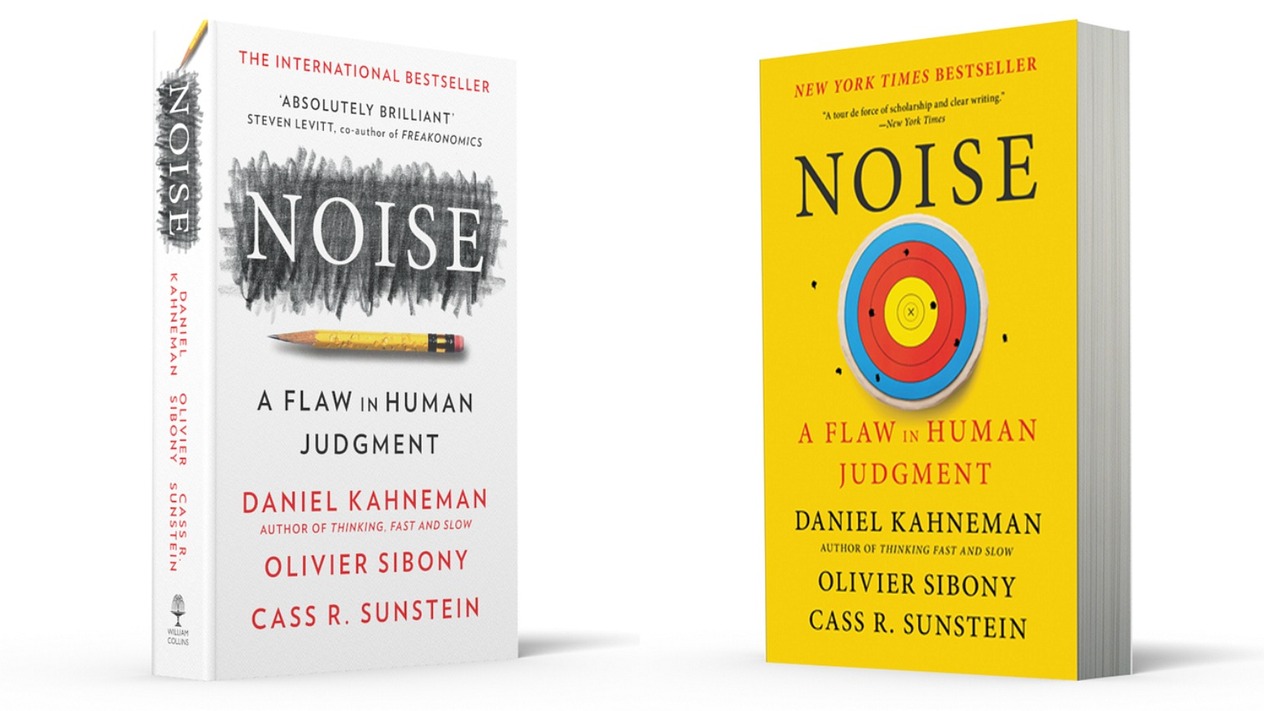
Daniel Kahneman, Oliver Sibony, and Cass R. Sunstein’s book Noise reveals an invisible variable that distorts decisions in every area of our lives from medicine to business, from sustainability to artificial intelligence. Demonstrating that many of the decisions we make intuitively in daily life stem not from systematic errors but from inconsistency, this striking work calls on both individuals and organizations to rethink their decision-making processes.
When I read Noise by Daniel Kahneman, Oliver Sibony, and Cass R. Sunstein, published in Turkish by Pegasus Publishing, I realized just how much noise we are exposed to in the world we live in and how this noise used here as a metaphor as well affects the decisions we make across different areas of life. Seeing this both concerned me and made me glad to encounter a book that helped me make sense of it.
Because in our daily lives, especially in recent years, the influence of social media, the changes brought about by post-pandemic life, economic conditions, political developments around the world, the impact points created in consumers’ minds, and finally the arrival of artificial intelligence have all contributed to an environment where we often fail to recognize noise. We get carried away by its momentum and move within it, making decisions that are not always the right ones. That is why I became genuinely curious when I came across this book and wanted to share it with you after reading and researching every detail.
The Book’s Core Argument: “Real-World Decisions Are Scandalously Noisy”
The book begins with a striking claim: the amount of noise in real-world decisions is often scandalously high. It provides alarming examples of noise in situations where precision and accuracy matter greatly. I would like to share some of the book’s most compelling observations.
According to the authors, medicine is noisy. When different doctors evaluate the same patient, they may reach different conclusions about whether that patient has skin cancer, heart disease, tuberculosis, depression, or many other illnesses. As one might expect, noise is particularly high in psychiatry, where subjective judgment plays a significant role. However, the authors point out that substantial levels of noise can also be found in unexpected areas such as the interpretation of X-rays.
A second example presented in the book is that forecasts are noisy. This particularly caught my attention because forecasting and scenario planning are critically important. So what do the authors say about this?
Forecasts are noisy because professional forecasters produce highly variable predictions on almost everything from the potential sales volume of a product to increases in unemployment rates and the likelihood of bankruptcy for struggling companies. They disagree not only with one another but also with themselves. For example, when software developers were asked on two different days to estimate how long the same task would take to complete, their estimates differed by an average of 71 percent.
Looking at these two examples, I believe we should first step outside the chain of noise and re-examine the decisions we make. That part is within our control. But how do we understand the level of noise in decisions made by others decisions that affect us even though they are not ours? That is exactly why I think this book is essential reading.
The authors continue by arguing that personnel decisions are noisy. People conducting job interviews often evaluate the same candidates very differently. Employee performance ratings can also vary significantly and often depend more on the evaluator than on the performance being evaluated.
I have been working in consulting for eighteen years, and one of the biggest issues I encounter in performance evaluations is the evaluator’s ability to give—and even receive—feedback. I believe companies would benefit from incorporating the concept of noise into their performance evaluation systems.
What else does the book discuss? The authors also argue that patent decisions are noisy. Researchers behind a pioneering study on patent applications emphasized the role of noise in the process. Whether a patent is granted may depend largely on which examiner happens to receive the application. Unsurprisingly, this variability creates fairness concerns.
In my view, similar issues arise in the appointment of expert witnesses in legal cases in our country. The level of expertise an expert witness possesses, whether they have relevant experience in a specific subject, and whether that experience has been formally validated are all factors that should be taken into consideration. When these critically important qualifications are absent, it becomes impossible to understand who is making decisions based on what criteria, why different people reach different conclusions on the same issue, and how those decisions affect us. We find ourselves right in the middle of noise.
The Anatomy of Noise: The Same Problem, Different Decisions
The central thesis of Kahneman and his co-authors is simple:
There are two things that distort decisions: bias and noise.
Bias is a systematic error that pushes judgment in a particular direction. Noise, on the other hand, is the random variability in decisions made by different people or even by the same person at different times when faced with the same problem. It is not a directional shift; it is a distribution error.
One of the most striking ideas in the book can be summarized as follows:
People fear bias, but they often fail to recognize the damage caused by noise.
Bias invites political, ideological, and cultural debate. Noise, by contrast, appears to be mere chance. Yet it is not chance; it is the byproduct of poorly designed decision systems.
Unconscious Confidence, Unsupported Predictions, and Bad Decisions: The Silent Chaos of Everyday Life
The same problem exists in consulting. Having worked for years in a corporate organization does not automatically mean someone possesses consulting competence. If you claim expertise in a subject, that claim should be supported by:
- Years of hands-on field experience,
- Serious education in the relevant area,
- Work shared across different platforms,
- Visibility in nationally and globally recognized channels,
- Accreditation from independent and credible institutions.
Without these, on what basis is someone considered an expert? What are their recommendations based on? Do they actually produce measurable results? We simply do not know. At that point, everyone’s voice blends into everyone else’s, and once again we find ourselves surrounded by noise.
In short, the book demonstrates one thing very clearly:
Good intentions do not equal good judgment.
Good judgment requires low-noise systems.
So what should we do about noise? Kahneman’s recommendation is not to throw intuition away entirely, but to reposition intuition within a framework of decision hygiene.
Noise Audit: Where Expertise Is Not Enough
In a famous Noise Audit conducted in the insurance industry, the same claim file was given to dozens of experts. The objective was to measure the level of noise within the organization.
The result: compensation estimates for the same case varied by more than 50 percent on average. One expert suggested 100 units, another 160, and yet another 70. None of them were acting in bad faith; they were all professionals genuinely trying to do their jobs well.
This study teaches us something important: expertise alone does not reduce noise. What reduces noise is the design of the decision-making process.
While reviewing this book and writing about such a fascinating subject, it would have been impossible not to bring art into the discussion.
1863 Salon des Refusés: Manet and the Rejected
In 1863, the Paris Salon jury rejected 2,783 out of approximately 5,000 submitted works. Following public backlash, Napoleon III ordered a separate exhibition for the rejected pieces: the Salon des Refusés.
Manet’s now-iconic painting Le Déjeuner sur l’herbe was exhibited in this “Salon of the Rejected.” The same city, the same period, yet jury members with dramatically different aesthetic judgments. It stands as one of history’s great examples of institutional noise one that changed the course of modern art.
“One jury found Manet rejectable; history placed him at the very backbone of art history.”
Today, the Salon des Refusés can be read not only as an art event but also as a historical record of noisy judgment.
Even today, companies often leave new ideas, different people, and unconventional perspectives outside the door by declaring them “not a fit.” Perhaps years from now, an idea rejected today will transform the game somewhere else entirely.
Booking.com: “Don’t Guess. Test.”
One of the best examples of how noise can be managed in practice is Booking.com.
The company’s philosophy is remarkably simple:
“Don’t guess. Test.”
This is not a marketing slogan; it is the engine behind the organization’s decision-making process.
Ideas are ranked not according to titles but according to test results.
It is not enough for a product manager to say, “I think this is how it should be.” The result of an A/B test is required. At that point, even the opinion of the president loses its authority.
Measured impact wins over hierarchical power.
Booking.com sometimes runs thousands of A/B tests simultaneously. This is not about eliminating human intuition; it is about testing intuition through experimentation. As a result, decisions are informed not by a manager’s mood on a particular day but by collective data. Noise is systematically trimmed away.
Netflix: Behavior Speaks Louder Than Feelings
Netflix follows a similar logic, focusing less on what customers say and more on what they do.
Rather than asking users, “Did you like this movie?” Netflix looks at:
- Where they stopped watching,
- Which scenes they replayed,
- Which thumbnail they clicked,
- How much time they spent with each genre.
As a result, decisions are not based on statements like “This series makes me feel good,” but on concrete patterns of behavior.
This is where Kahneman’s principle that “a good decision is not a good idea; it is a consistent process” becomes tangible. At Netflix, decisions depend less on the weight of a single executive and more on the strength of the signals produced by the system.
Oakland Ballers: When Artificial Intelligence Takes the Field
In 2024, the Oakland Ballers baseball team entrusted an entire game almost completely to artificial intelligence.
A system called “AaronLytics” made a significant portion of the decisions regarding lineups, substitutions, and tactics during the game. The coach was still present, but an algorithm tracked the flow of the game and generated data-driven recommendations. The team won.
Oakland Ballers manager Aaron Miles described the experience as follows:
“Artificial intelligence is scary for everyone because it could take everyone’s job. But what we’re doing right now is exciting because baseball is a game built on statistics and analytics. If you have the ability to compile statistics at lightning speed, there may be a place for it in the game and there probably will be. In what capacity, I don’t know.”
The most important point is this: the experiment shifted the conversation away from the question, “Can artificial intelligence beat humans?” toward a different one:
“How much noise can artificial intelligence remove?”
A coach might manage the exact same game scenario very differently on different days. Fatigue, stress, crowd pressure, and previous game experiences all influence decisions. Artificial intelligence, if properly trained, has the potential to solve the same problem using the same logic every time.
From a management perspective, this is both unsettling and instructive. In the future, great leadership may belong not to those who know everything themselves, but to those who can build systems capable of testing their own intuition.
Recently, I watched the Michelin Guide Turkey ceremony live. The aspect that interested me most was the Green Star awards.
For the past six years, I have been working on sustainability, sharing my ideas and research on both national and international platforms. I am also a co-founder of two sustainability-focused startups operating internationally. Naturally, I wanted to examine where noise might exist within the Green Star system.
Sustainability, the Green Star, and Noise
One of the areas most vulnerable to noise is sustainability.
Recently, the Michelin Green Star has become a major topic of discussion in the culinary world. On paper, the objective is clear: to highlight restaurants that genuinely embrace sustainable practices.
According to the Michelin Guide, there are now more than 500 Green Star restaurants across over 40 countries. The criteria include local sourcing, waste reduction, energy and water efficiency, and supply-chain transparency.
However, both globally and in Turkey, one question is being raised more frequently:
Is this star always awarded with the same level of rigor? Or does it sometimes carry the risk of noise, caught somewhere between vaguely defined criteria and communication campaigns?
On one side, there are truly exceptional examples. Baldío in Mexico City, for instance, aims to operate as a restaurant with no trash bins. It follows zero-waste principles in its kitchen. Food scraps are fermented and transformed into sauces, beverages, and spices, while a significant portion of its ingredients comes from local regenerative farms using ancient Aztec agricultural methods. This approach earned the restaurant a Michelin Green Star and, according to many observers, genuinely reflects the spirit of the award.
On the other hand, it remains open to debate whether every Green Star restaurant in every market operates within such a robust framework of data and reporting. Academic studies suggest that while Green Star restaurants often appear sustainable in their messaging, the methods used to measure criteria and the level of transparency can vary considerably in practice.
This brings us back to the concept of noise.
Sustainability gains meaning not through intention, but through measurement.
If criteria are unclear, data is not transparent, and audits are not independent, the same Green Star may represent a genuine commitment in one country and merely a communication tool in another. That creates noise within what is intended to be a global standard.
So What Do We Do?
Kahneman’s book left me reflecting in two ways.
First, I realized that I need to re-examine my own decisions.
I need to distinguish between the decisions in which I am being carried along by noise and those in which I am truly acting systematically.
Second, I realized that I must account for the possibility that decisions made by others whether doctors, CEOs, jury members, managers, or investors may also contain noise.
Behind every decision lies a question:
“What process produced this outcome, and what mechanisms exist within that process to reduce noise?”
I see the same challenge in the organizations I advise. Performance evaluations, talent management, promotions, bonuses, rewards, and disciplinary actions if these are based solely on a manager’s personal feelings, then no matter how sophisticated the forms may be, the resulting decisions remain fundamentally noisy.
Yet the solution is not impossible:
- Define decision criteria in advance,
- Use multiple evaluators systematically,
- Break decisions into stages,
- Support decisions with data and experimentation whenever possible,
- Most importantly, position leaders not as owners of outcomes but as architects of decision processes.
Noise teaches us this:
Making the right decision once is not enough.
The real question is:
Can we make the same decision repeatedly under similar conditions?
Accuracy may be a matter of insight.
Consistency, however, is a matter of systems.
And that is precisely where noise loses.
Link : https://www.forbes.com.tr/forbes-life/noise-dogru-kararin-yanilsamasi-ve-gorunmez-risk
