
Hanzade Acar
March 2, 2026
In the business world, we often view change as a crisis, a project that needs to be managed, or a form of turbulence that must be navigated safely from Point A to Point B. We spend millions on change management programs and break the process down into KPIs.
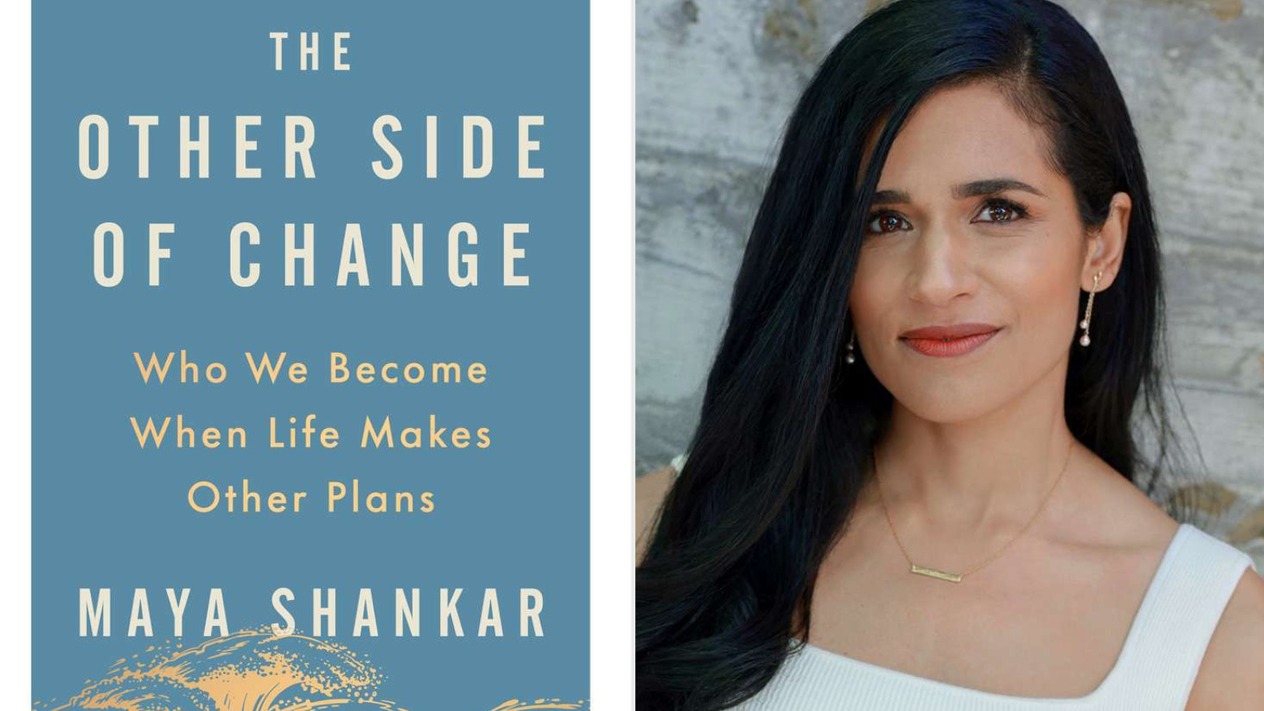
Lately, I have not been able to put down The Other Side of Change, published by Riverhead Books (Penguin Random House) in 2026. Brené Brown and Adam Grant quickly embraced it as a must-read. The book completely transforms our perspective.
Its author, Maya Shankar, argues that change is not a crisis to be managed but something to be embraced like a new identity. In making her case, she relies not only on emotions but also on evidence from cognitive science.
From Juilliard to the White House: An Unexpected Career Transformation
Maya Shankar’s story is even more compelling than the book’s theory.
As a child prodigy, she grew up carrying the labels “student of Itzhak Perlman” and “future violin virtuoso.” She was accepted into the prestigious Juilliard School and had oriented her entire life toward a single destination: music.
For her, “Maya” meant “violin.”
Then one morning, everything changed.
A sudden pain in her hand and a rare diagnosis brought that future to an abrupt end. With a single sentence, doctors took that identity away from her:
“You will never play the violin at that level again.”
Sometimes I find myself asking: If I could no longer do the work I do today, how would I describe myself?
Rather than surrendering to the difficulty of her situation, Maya dedicated herself to understanding how the human mind responds to change. She studied at Oxford as a Rhodes Scholar, earned her PhD at Stanford, and eventually joined the White House during the Obama administration. There, she founded the Social and Behavioral Sciences Team, which designed public policies by studying human behavior.
Today, Shankar is also the creator of A Slight Change of Plans, the podcast selected by Apple as “Best Show of the Year.”
In this book, she is essentially mapping the science behind her own transformation.
The Most Dangerous Investment: Identity Foreclosure
One of the ideas in the book that will resonate most strongly with people in the business world is Identity Foreclosure.
We all understand the importance of diversifying financial assets. We would never invest all of our money in a single stock.
Yet Shankar argues that when it comes to identity, most of us make exactly that mistake.
We become so attached to one thing our job, our title, or our role that when that “stock” loses value, whether through retirement, crisis, or unexpected change, we experience emotional bankruptcy.
For Forbes readers, the critical question is this:
When you place your business card on the table, what remains of you?
Shankar argues that identity should not be a fixed statue. It should be flexible clay.
A Philosophical Paradox: Theseus’s Ship
Maya Shankar’s exploration of the question “Who are we?” reminded me of one of Ancient Greece’s most famous paradoxes: Theseus’s Ship.
According to the legend, the ship of the hero Theseus was preserved in the harbor of Athens. Over time, its wooden planks began to decay. One by one, the old planks were replaced with new ones until eventually every part of the ship had been changed.
Nothing original remained.
The question is simple:
Is it still Theseus’s ship?
Human life works much the same way.
The cells in our bodies constantly regenerate.
The thoughts in our minds evolve over time.
The work we do may change.
Most of our original parts disappear.
So are we still ourselves?
In the book, Shankar argues that change does not destroy something; it creates order.
Many leaders compare change to repairing an old boat.
Yet sometimes the ship is no longer a ship.
Sometimes it has become an airplane and must learn not how to float, but how to fly.
A Lesson from Music History: Playing the Piano with One Hand
As I read about Maya losing her violin, I found myself thinking about Paul Wittgenstein.
Paul was the brother of the famous philosopher Ludwig Wittgenstein and one of Europe’s finest pianists. During the war, however, he lost his right arm.
If a pianist loses his right arm, one might assume everything is over.
But Wittgenstein did not turn his back on music.
Instead, he approached composers such as Ravel and Strauss and asked them:
“Write concertos for the left hand only.”
The result was a series of extraordinary works that became part of music history.
This is what Maya Shankar calls cognitive flexibility.
Had Wittgenstein insisted on maintaining the identity of “a pianist who plays with two hands,” he might have lived the rest of his life as a bitter and unhappy veteran.
Instead, he focused on the resources he still possessed and created new art from within his limitation.
The Trapeze Artist’s Secret and “That Terrifying Gap”
But what about those frightening moments between letting go of an old identity and embracing a new one?
Maya Shankar calls this Liminal Space.
Whenever I think about this concept, I remember a little-known conversation Henri Nouwen once had with a trapeze artist.
The performer described the most dangerous moment of the act:
“The audience sees me flying through the air, but the real secret is letting go. There is a moment between releasing the bar I’m holding and being caught by the catcher on the other side. In that moment, I’m holding onto nothing. I’m completely suspended, completely vulnerable. If I don’t let go of the old bar, I can never reach the new one. Trapeze artists aren’t afraid of dying. They’re afraid of remaining suspended in that space. But the magic happens there.”
This is the pain we experience in both corporate life and personal transformation.
Our old identity being a violinist, being a CEO, being young has slipped away.
Yet our new identity has not caught us yet.
Rather than panicking in that space, Shankar suggests allowing the gap to reshape us.
Because flying is not about holding on.
It is about being able to let go.
Kintsugi and the Beauty of What Breaks
At the end of the book, Maya Shankar leaves us with a mindset reminiscent of the Japanese art of Kintsugi.
Kintsugi masters do not throw away broken ceramics.
Instead, they reassemble the fragments using a resin mixed with gold powder.
What matters is not hiding the crack but honoring it.
Because the crack becomes part of the object’s history, experience, and value.
When Maya lost her violin, she thought she had lost music.
Yet when she was creating policies that improved people’s lives in the White House, or inspiring millions through her podcast, she was still making music.
Only the instrument had changed.
The violin was gone.
Human stories had taken its place.
Today, ask yourself this:
When life puts its own plans into motion, when your title or your favorite “toy” is taken away from you, what will you do?
Will you sweep away the broken pieces and throw them out?
Or will you use gold to transform them into something far more valuable a unique work of art?
Remember:
There is no Plan B.
There is only the new life you are living right now, waiting to be discovered.
