
Hanzade Acar, Forbes Türkiye
July 10, 2026
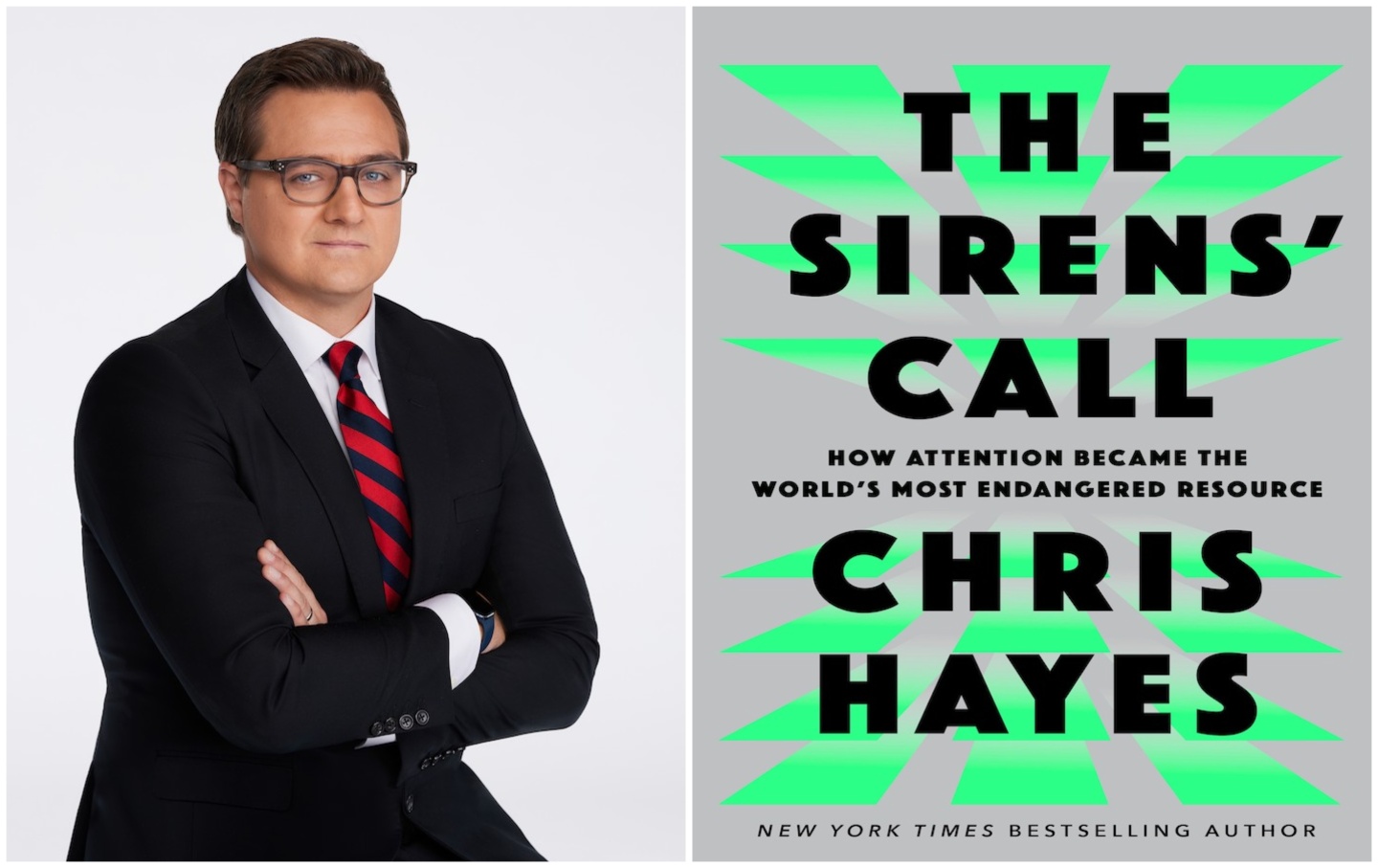
Journalist Chris Hayes’s book The Sirens’ Call explores how our attention is processed and transformed into a commodity. Hayes places Homer’s Odyssey at the center of his narrative.
When we open our eyes in the morning, are we really the ones beginning the day?
At first glance, you may find this question strange. After all, most of us follow roughly the same morning routine. The alarm goes off, we pick up our phone, and check the time. Then, often without even realizing it, a small journey begins on the screen. The emails that arrived overnight, a message from a friend, news alerts, the social media feed, the weather, the calendar… Before we have even gotten out of bed, our minds have already come into contact with dozens of different stimuli.
The most important decisions of the day have already been made before we have even had our coffee.
Because those first few minutes in which we encounter these stimuli actually determine who will direct the rest of the day.
Our attention?
Or the world that wants our attention?
We do not experience this only in the morning.
In the middle of a meeting, the screen of a phone lying on the table suddenly lights up. Perhaps no one reaches for it, yet everyone’s eyes instinctively drift toward it. During dinner, while a child is excitedly telling a story about something that happened at school, a mother or father says, “Just a second…” and glances at their phone. That one second often turns into thirty seconds, sometimes even several minutes. The conversation appears to continue where it left off, but in reality, it doesn’t. Because attention has already left the table.
What is striking is that all of this now feels perfectly normal to us. The greatest problem of our age is that losing our attention has become ordinary.
Never in human history has attention been this valuable.
Today, we no longer need to visit great libraries to access information. Courses from the world’s leading universities, groundbreaking research, and millions of books are only a few taps away. Information has never been more abundant. Communication has never been faster. Technology has never been more powerful.
Yet despite all of this, we find ourselves repeating the same familiar phrases more and more often:
“I can’t read books the way I used to.”
“I can’t stay focused through an entire movie.”
“I forget why I picked up my phone.”
“I never have time to think.”
The problem is not a lack of information.
Quite the opposite.
It is an excess of information.
More importantly, the voices competing for our attention have become louder than ever before.
Once upon a time, there were town criers in public squares. Then came newspapers. After that, radio, television, and the internet. Every new communication technology expanded humanity’s horizons. But at the same time, it also multiplied the number of voices competing for space in our minds.
Today, those voices no longer come from outside.
They speak to us from the small screens we carry in our pockets.
As I was thinking about how to quiet those voices, a book I read a few weeks ago did something that no book had done for me in a very long time. Rather than teaching me something entirely new, it revealed a truth I live with every day but had gradually stopped noticing.
A book I read a few weeks ago, while I was thinking about how to quiet those voices, did something no book had done for me in a very long time. Rather than teaching me something entirely new, it revealed a truth that I experience every day but had gradually stopped noticing.
MSNBC host and journalist Chris Hayes’s The Sirens’ Call: How Attention Became the World’s Most Endangered Resource, published by Penguin Press, initially appears to be another contemporary book about technology and social media. But as the pages unfold, you realize that Hayes is not trying to direct our attention toward technology. Instead, he is retelling one of humanity’s oldest struggles.
The struggle for attention.
There is a scene in the opening pages of the book that made me stop reading for a moment. Hayes describes reading a book with his six-year-old daughter while the phone in his pocket constantly called out to him. To describe that feeling, he invokes Gollum’s relationship with the Ring in J.R.R. Tolkien’s The Lord of the Rings. In the novel, Gollum becomes so consumed by the Ring’s power that he no longer sees it as a mere object, but as an irresistible obsession he calls “my precious.” The Ring becomes an invisible force that constantly pulls its owner back to itself, never allowing him to escape its grip.
Hayes’s phone served much the same function. It had ceased to be an ordinary device sitting in his pocket and had become an invisible magnet, relentlessly pulling his attention toward it.
As I read those lines, I found myself smiling.
Because I suspect that all of us carry a small ring in our pockets.
The problem is not that we hold our phones in our hands.
The problem is how much space our phones occupy in our minds.
Hayes builds his book around a statement by the American philosopher and psychologist William James a sentence that remains remarkably relevant today:
“My experience is what I agree to attend to.”
At first glance, it seems like a simple observation.
But the longer you sit with it, the more you begin to see life itself through a different lens.
If our experiences are shaped by whatever we choose to pay attention to, then losing our attention is not merely a problem of concentration.
It also means surrendering part of our lives to someone else.
That was one of the ideas in the book that affected me the most.
Now let’s look at where this brings us.
The greatest challenge of our time is not time management.
It is attention management.
Surprisingly, the book does not begin in Silicon Valley or inside a technology company. Instead, it opens with an epic poem written nearly three thousand years ago:
Homer’s Odyssey.
At first, this choice feels unexpected. Why would a book about artificial intelligence, algorithms, and social media return to Ancient Greece?
Hayes’s answer is remarkably compelling.
Technology may have changed, but the human mind has remained largely the same.
The Sirens’ song may reach us today through different channels, but the brain that hears it possesses the same vulnerabilities, the same curiosity, and the same fragility as the brain Odysseus carried three thousand years ago.
As I read the book, this was perhaps the idea that made me think the most.
The greatest misconception of our age is believing that the challenges we face are entirely new.
In my view, what is new are the tools.
What is ancient is the human being.
In every era, people have lived surrounded by voices competing for their attention.
Only the Sirens have changed.
Odysseus and the Sirens: Humanity’s First Story of Attention
Nearly three thousand years ago, when Homer wrote The Odyssey a work that is still regarded as one of humanity’s greatest epics he could never have imagined smartphones, social media algorithms, or artificial intelligence.
And yet the story he told has become one of the most powerful metaphors we have for understanding the world we live in today.
The Trojan War had ended.
After ten years of conflict, Odysseus, King of Ithaca, was trying to return home. But the journey home proved even more dangerous than the battlefield itself. Along the way, he encountered giants, violent storms, the wrath of the gods, and terrifying sea monsters.
Yet among all these obstacles, there was one that could not be defeated with a sword or overcome by force.
Because this enemy did not attack.
It sang.
At one of the most critical moments of his journey, Odysseus encounters the enchantress Circe. She warns him that ahead lies an island inhabited by the Sirens, and she offers a crucial piece of advice.
The Sirens’ song is so irresistible that no sailor who hears it can continue on his course. He turns his ship toward the shore, steps onto the island, and never returns home again.
According to Homer, the island’s coastline is littered with the bones of sailors who, over the years, had surrendered to the Sirens’ call.
At first glance, it seems like one of mythology’s extraordinary tales.
But if we pause for a moment, the Sirens’ method begins to feel strikingly familiar.
They never force anyone off the ship.
They never chain anyone down.
They never threaten anyone.
They simply appeal to humanity’s greatest weakness:
Curiosity.
The words Homer gives the Sirens are particularly revealing. They do not promise Odysseus wealth.
They do not promise him power.
Nor do they offer immortality.
Instead, they tempt him with something far more seductive:
Knowledge.
“Come here, Odysseus,” they call. “Everyone who has listened to our voices has left this place wiser than before.”
Reading those words, I couldn’t help thinking about today’s digital world.
Don’t we fall into these same traps every single day?
“A video you absolutely have to watch…”
“Don’t miss this story…”
“Recommended just for you…”
“Up next…”
The words have changed.
The invitation has not.
Every one of these messages is really saying the same thing:
“Just give me a few minutes of your attention.”
This is precisely what makes Chris Hayes’s book so distinctive.
Hayes uses the story of the Sirens not merely as a mythological tale, but as a universal metaphor for the nature of human attention. In his view, the Sirens were never simply mythical creatures living in the sea. Every force capable of pulling the human mind away from its own will resembles the Sirens in some way.
Today, those forces may take the form of algorithms, notifications, advertisements, or endless streams of content. But the human mind responds to them much as it did thousands of years ago.
This is where we truly understand Odysseus’s greatness.
He did not become legendary because he refused to hear the Sirens’ song.
He became legendary because he knew exactly what would happen if he did.
After listening to Circe’s warning, he orders his crew to melt beeswax and seal their ears. No one aboard the ship will hear the Sirens’ song.
Then comes his own turn. He gives one of the most extraordinary instructions in literary history. He orders his men to tie him tightly to the ship’s mast. But he tells them something more:
“No matter what I say, no matter how much I beg, you must not untie me. If I ask to be released, tighten the ropes even more.”
The first time I read this passage, I found myself thinking about it for a long time. Odysseus’s true wisdom was not that he feared the Sirens. It was that he knew himself. He understood the limits of his own willpower. He accepted that the decision he made today might not be the same decision he would make tomorrow once he heard the song. So he used today’s clarity to protect tomorrow’s weakness.
In fact, this is one of the earliest examples of what modern behavioral science calls precommitment.
A person makes a decision in advance about a situation they know will test them in the future, then creates a system that forces them to remain faithful to that decision.
Today, we do the same thing in different ways. We turn off phone notifications. We leave our phones in another room while we work. We close our laptops during meetings. When we’re having dinner with our children, we try not to place our phones on the table. All of these are, in a sense, the modern world’s small masts.
Given the conditions of today’s world, the issue is not having strong willpower. It is recognizing that willpower cannot remain strong all the time.
That is why the story Homer told three thousand years ago still feels remarkably relevant. The Sirens never lived only in the middle of the sea. They have always existed within every call capable of redirecting human attention. The only thing that has changed is the melody of their song. This is the transformation Chris Hayes emphasizes throughout the book. For years, we have heard the phrase, “Data is the new oil.” Hayes offers an important challenge to that idea. Data can be replicated.
The same information can exist in the hands of billions of people.
Attention cannot.
It can be directed to only one place at a time.
And it is precisely this scarcity that gives it its value.
Every Era Creates Its Own Sirens
When Odysseus’s ship sailed beyond the island of the Sirens, the story did not end. Homer’s epic came to a close, but humanity’s struggle with attention was only just beginning. Three thousand years passed. Empires rose and fell. Continents were discovered. Science advanced. The steam engine was invented. Electricity illuminated cities. The internet connected the world. With every century, humanity created new technologies. Yet amid all these extraordinary transformations, one thing remained almost unchanged:
The human mind.
The smartphones we hold in our hands today are remarkably new. But the brain using them still carries the same biological inheritance as the brain that heard the Sirens’ song thousands of years ago. It is curious. It is drawn to novelty. It notices the unexpected. And it is naturally inclined to have its attention pulled from one thing to another. That is why history is not merely the story of inventions. It is also the story of who has succeeded in capturing our attention and how. One of the first great revolutions in attention began with the invention of the printing press. When Johannes Gutenberg developed movable type, he did far more than accelerate the production of books. For the first time, knowledge became widely accessible to ordinary people. Literacy spread across Europe. Scientific thought accelerated. The Reformation gained momentum.
Knowledge was becoming freer with every passing generation. But every new freedom also brought a new burden of choice. For centuries, people had chosen among only a handful of handwritten manuscripts. Now they faced hundreds of books.
For the first time, the human mind confronted a new question:
“I can’t read them all. So which one should I choose?”
That question, so familiar to us today, was in many ways one of the earliest signs of the attention economy. When newspapers multiplied during the nineteenth century, the competition took on a new form. The newspaper vendors who filled the streets at dawn were not simply selling news. They were competing for people’s attention. That is why headlines became larger, bolder, and increasingly sensational. The feeling of “I have to be the first to know” became one of the foundations of modern news culture. When radio entered people’s homes, many thinkers predicted it would transform family life. Then television arrived. The screen that occupied the center of the living room did more than deliver the news. It reshaped the rhythm of daily life. Dinner schedules began to revolve around television programs. Advertising evolved into one of the world’s most powerful industries. A product was no longer judged solely by its quality, but also by how much space it occupied in people’s memories.
This is one of the pivotal shifts Chris Hayes highlights throughout his book.
Because the transformation was not merely technological.
It was economic.
For the first time, attention became a resource that could be systematically measured, bought, and sold. Companies were no longer valued only for the quality of what they produced. They were also valued for how long they could keep people looking at their screens. Today, the success of a news website is not measured solely by the accuracy of its reporting. The success of a video is not determined only by its quality. The value of an app is calculated by the amount of time people spend using it. Whether we realize it or not, we now live inside a new kind of economy. And the currency of this economy is neither dollars, euros, nor Bitcoin.
It is attention.
Attention is not a resource that can be extracted like oil or stored like gold. It can be directed to only one place at a time. That is precisely why it has become more valuable than ever before in human history. Much of the exhaustion we experience today is not physical.
It is mental.
Because every day, hundreds of invisible voices ask us the very same question:
“Will you look at me?”
But why does our brain respond to these calls so effortlessly?
One of the most fascinating chapters in Chris Hayes’s book is titled “The Slot Machine and Uncle Sam.” At first, it is difficult to understand what slot machines could possibly have to do with the attention economy. But as the chapter unfolds, Hayes demonstrates that social media platforms operate according to the very same psychological principle that makes slot machines in Las Vegas so addictive. What makes a slot machine addictive is not that it rewards you every single time. Quite the opposite. It is that you never know when the reward will come. In behavioral science, this is known as a variable reward system. A remarkably similar cycle begins every time we pick up our phones. We don’t know what the next notification will be. We don’t know what the next video will show us. We don’t know whether the next email will bring good news or another problem. It is uncertainty itself that keeps our attention constantly engaged. That is why the problem is not that our willpower is weak.
The real problem is that the mechanisms our brains developed over millions of years are now deeply understood and deliberately leveraged by digital platforms worth billions of dollars.
The Power of Silence
We are not the first people to search for ways to protect our attention. Humanity has been pursuing the same question for centuries.
One of the simplest, yet most profound examples can be found in the rock garden of Ryōan-ji Temple in Kyoto, Japan. People travel from all over the world to see this garden. Yet many first-time visitors share the same reaction:
“Is that all?”
There are no dazzling flowers. No monumental sculptures. No elaborate architectural displays. Only a handful of rocks, white gravel, and an expanse of empty space. What initially appears to be incomplete is, in fact, intentionally so. According to Zen philosophy, the mind begins to truly see only after unnecessary stimuli have been removed. Here, emptiness does not represent absence. It represents a space where attention is finally able to breathe.
The philosophy embodied by the Zen garden has always reminded me of Claude Monet.
During the final thirty years of his life, Monet painted the same pond and the same water lilies in Giverny hundreds of times. At first glance, this seems repetitive. But what he repeated was not the pond. It was his way of seeing. By returning to the same landscape under different light, at different hours of the day, and in different seasons, he revealed something profoundly important: Depth does not come from constantly searching for something new. It comes from being able to look at the same thing for a longer time.
I believe this is the very ability we are beginning to lose today.
Lately, I have become increasingly aware of just how many things compete for my attention. And they are not only notifications, emails, or phone calls. They are people, too. Sometimes I find myself thinking that solitude is one of the greatest fuels for human performance. The more we surrender our attention to others, the more we unknowingly surrender many of the moments that make life meaningful. I also believe culture plays an important role here. Choosing not to interrupt someone else’s attention is, above all, an act of respect.
It is almost as though silence has become the greatest fear of our age. We feel compelled to fill every moment with another sound, another image, another notification. Yet the human mind often needs not more information, but more space. That is why one of the stories that captured my attention most was that of Victor Hugo.
While working on Les Misérables, Hugo imposed a rule on himself that seems rather unusual at first. To prevent himself from procrastinating, he asked his assistant to lock away all of his clothes. With nothing suitable to wear outside, he had no choice but to remain in his room and write. As I read this story, I couldn’t help thinking about Odysseus. Odysseus had himself tied to the mast of his ship. Victor Hugo tied himself to his writing desk. Thousands of years separated the worlds they lived in. Yet they both accepted the same truth: Willpower alone is not always enough.
Sometimes what leads us to our destination is not our strength, but our ability to anticipate our moments of weakness before they arrive.
Throughout Chris Hayes’s book, these two images remained side by side in my mind.
On one side, a ship approaching the song of the Sirens.
On the other, a writer in Paris shutting himself away in his room.
Both were engaged in the very same struggle:
The struggle to protect their attention.
More often than not, it is the same struggle I find myself facing as well.
A Company That Respects Attention
As I was reading Chris Hayes’s book, I found myself thinking about the Trader Joe’s stores here in Los Angeles. At first glance, they seem like nothing more than neighborhood grocery stores. But the more time you spend inside one, the more you realize that they have designed a fundamentally different kind of customer experience. Today, many retailers try to keep customers in their stores for as long as possible. Larger screens. More products. More promotions. More choices. Trader Joe’s does exactly the opposite.
The moment you walk into the store, you are not confronted with hundreds of nearly identical products. Instead of overwhelming you with dozens of alternatives in every category, the shelves present a carefully curated selection of products. This approach does more than simplify the shelves. It simplifies the customer’s mind. Because, in my view, a great customer experience is not about offering more choices. It is about making decisions easier. But product selection is only part of what makes Trader Joe’s different. Its employees are just as important to the experience. When you arrive at the checkout, you are rarely greeted with scripted sales lines. Instead, someone might ask,
“What are your plans for today?”
“Is this your first time trying this product?”
or,
“You really should try this with our…”
A conversation begins naturally. That brief exchange transforms shopping from a simple transaction into a genuinely human encounter. Trader Joe’s success comes from this holistic approach to storytelling. It does not try to seize the customer’s attention. It begins by respecting it.
After finishing Chris Hayes’s book, I found myself thinking about the future of the attention economy. The companies that will truly stand out will not necessarily be the ones that keep people staring at screens for the longest amount of time. I believe this is where many organizations are making a fundamental mistake. My own experience has led me to a different conclusion. The companies that will define the future are those that reduce people’s cognitive load, make decisions easier, and design experiences that allow people to feel human again.
The competitive advantage of the future will not come from demanding more attention.
It will come from earning it.
Link : https://www.forbes.com.tr/icerik-ureticileri/sirenlerin-cagris
