
Hanzade Acar
November 1, 2025
The “Let Them” philosophy is about the inner freedom that comes from stopping the management of others and returning to your own energy.
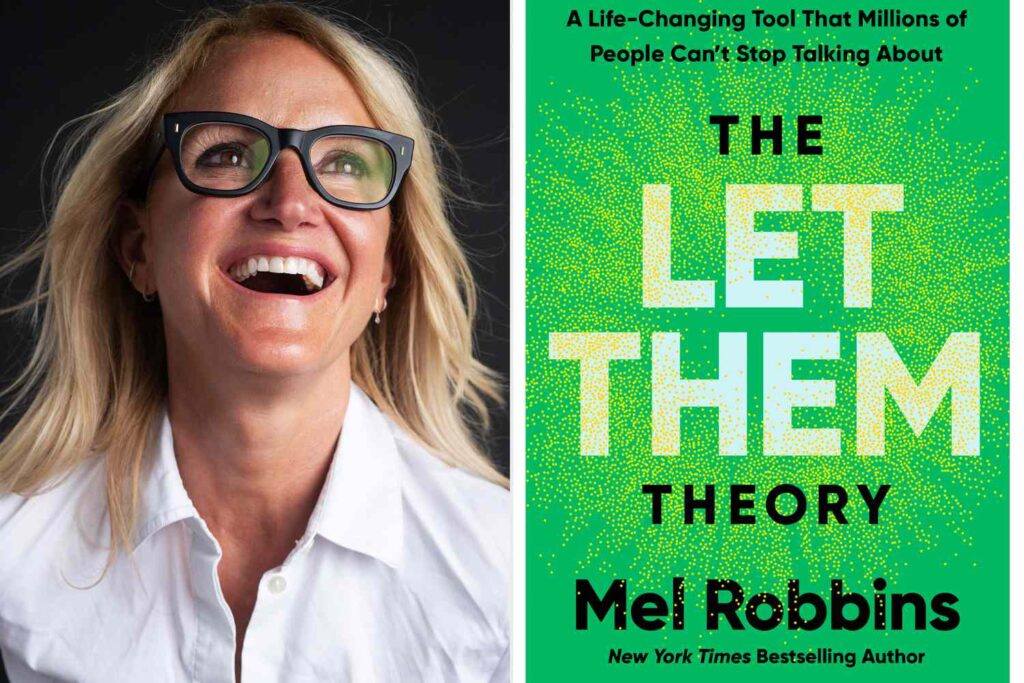
A journey from Mel Robbins’ The Let Them Theory to my own story
Melanie Lee Robbins is an American author, podcast host, and attorney. I first discovered Robbins through her talk, How to Stop Screwing Yourself Over, and I have followed her ever since because she openly advocates for the things most of us are afraid to say out loud. Every word she writes creates the effect of a life preserver thrown to us when we are in the middle of the ocean and no longer have the strength for another stroke.
Today, I would like to share her book, The Let Them Theory, in which she explains the magical method that has made a difference in the lives of millions. If, like me, you have a multipotentialite mindset and a restless brain, and if you sacrifice too much of yourself to keep things from going wrong, this article may be the light at the end of the tunnel for you.
A few months ago, while wandering through Barnes & Noble in Los Angeles, I came across this book and then could not put it down. It has been translated into Turkish, and Nepal Publishing released its third edition in July 2025. So, let’s uncover the magic together.
Sometimes we want to keep everything under control. In our work, our relationships, our projects, as parents, as spouses, as entrepreneurs, as employees, or as leaders. If something goes wrong, we immediately try to fix it. If a crisis emerges, we rush to resolve it.
I was exactly like that.
I was someone who could not tolerate things going badly, who wanted everyone to be happy, who searched for something that needed fixing even in silence. Then one day I picked up Mel Robbins’ The Let Them Theory.
The title was so simple:
“Let Them.”
But as I turned the pages, I realized there was incredible depth hidden within that simplicity. In fact, trying to manage life is often a way of escaping it.
In the first part of the book, Robbins is remarkably honest. She talks about a period when she had completely lost herself: a forty-one-year-old woman, unemployed, carrying $800,000 in debt, and with no idea what to do next. She watches her friends rise quickly while dwelling on her own losses and struggles. To cope with anxiety and self-doubt, she develops a strategy: escape.
Escaping and procrastinating are the brain’s fast but temporary reward traps. We procrastinate and run because we do not want to face what is in front of us. Victor Hugo was also constantly postponing his writing during the summer of 1830. When he realized he would not be able to keep the promise he had made to his publisher, he put all of his clothes into a trunk and gave it to a friend because he needed to stay home and write. He confronted himself and the reasons behind his procrastination. In short, he said, “Let Them.” He stopped caring about what others thought, and as a result, the manuscript was delivered to his publisher two weeks before the deadline. The Hunchback of Notre-Dame was published on January 14, 1831, two weeks early.
During one of those hopeless periods, on a morning when she could not get out of bed and was trapped in yet another repetitive cycle, Robbins remembered NASA’s launch countdown. It was during that time that she discovered and began using the method that would later become known as the “5 Second Rule”: 5-4-3-2-1 move. Don’t think. Just act. That rule saved her life. It showed her that action is the answer. But the real transformation came later, with “Let Them.”
Sometimes people become so preoccupied with managing the emotions, decisions, and thoughts of those around them that they stop living their own lives. Over time, this turns into a hidden addiction to control.
While reading the book, I found myself reflecting.
I realized how many “fixing reflexes” I have carried throughout my life.
A dissatisfied client, a friend’s silence, tension in a meeting, people who struggle to empathize I treated all of them as if they were problems I had to solve. Yet most of the time, people need the freedom to find their own way. And our own freedom begins at exactly that point.
The concept that fascinated me most in the book was the relationship between “Let Them” and “Let Me.” Allowing a person or a situation to be what it is is not passive acceptance. When you say “Let Them,” what you are really saying is, “I am going to redirect my energy toward my own life.”
Sometimes this means leaving a community. Sometimes it means leaving a person. And sometimes it means leaving the city you live in.
That realization was incredibly important for me.
When you let go of something or someone, you think you are losing them. In reality, you are becoming free. For the first time, you feel your own energy returning to you.
Letting Life Flow Is Not Easy, But It Is Possible
For many years, I have shared the stories behind people, companies, and brands. Along the way, those stories have taught me that there are times when letting go is possible. While reading Robbins, I found myself thinking about company stories because “Let Them” is not only an individual philosophy—it is also a cultural one.
Let’s think about Netflix.
In 2009, Netflix founder Reed Hastings made a revolutionary decision: there would no longer be approval chains, permission processes, or thick procedure manuals within the company. In the famous Freedom & Responsibility Culture Deck, one statement stood out:
“Rules are for weak teams. We hire strong people. Let’s trust them.”
Netflix leaders stopped trying to control the decisions employees made.
What does that mean?
Let Them.
And what happened as a result?
Employee engagement reached record levels. The pace of innovation accelerated. A culture emerged in which people were no longer afraid of making mistakes. To this day, the motto remains the same:
“People come before processes.”
Toyota offers another example. Every worker has the right to stop the production line. They pull a cord known as the Andon Cord, and a billion-dollar system comes to a halt. Why? Because the company believes this:
“Let them stop it. Quality begins with trust.”
Michelangelo approached his work in a similar way. While sculpting David, he did not see himself as someone shaping marble. On the contrary, he described himself as someone freeing what was already inside the stone.
“I am simply removing the excess.”
This is perhaps an artist’s own version of “Let Them.”
In life, sometimes the only thing we need to do is remove the excess. To give people, ideas, and emotions the space they need to find their own form.
Letting Go Is Not Passivity, It Is Wisdom
One of the sentences in the book that affected me most was this:
“The more you rescue people, the more you help them sink.”
As a parent, that sentence made me think deeply.
We protect our children with good intentions. We support them. We believe we are guiding them. Yet sometimes we stand in the way of them discovering their own strength.
Sometimes helping means not interfering at all.
Allowing them.
Allowing them to fall, to try, and to learn.
This is an extremely difficult and painful process to manage, but its reward is priceless.
When I learned this, a major transformation began in my own life.
Now, instead of explaining everything to the people around me, I simply ask the right questions.
I allow them to find the answers themselves.
And when that happens, both confidence and responsibility grow.
I used to believe that being strong meant never losing control.
Now I know that being strong sometimes means choosing to do nothing.
Today, both in my professional and personal life, I remind myself of this whenever a plan falls apart, someone drifts away, or an idea fails to receive the attention I expected.
I simply say:
Let Them.
Let it be.
And then I add:
Let Me.
What can I do now?
